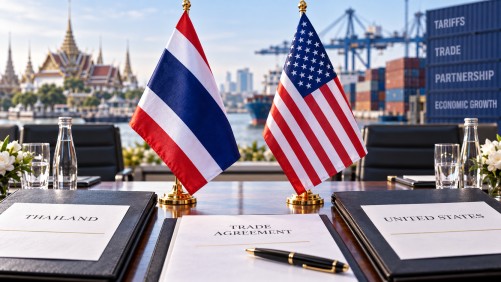
Thailand’s exporters could soon face reduced uncertainty and improved market access in the United States as Bangkok pursues a reciprocal trade agreement aimed at mitigating potential tariff increases. The negotiations, which are currently ongoing, seek to protect Thai exports from a looming 12.5% tariff imposed under a Section 301 measure related to forced labor issues.
Thai Prime Minister Anutin Charnvirakul is expected to engage in discussions with U.S. President Donald Trump on these trade talks and existing tariff conditions. The United States initiated a separate investigation in March 2026 concerning excess production capacity in Thailand and other prominent trading nations, which might lead to additional duties on Thai exports.
In an effort to address U.S. concerns, Thai officials have provided data challenging Washington’s estimates of Thailand’s production capacity and potential transshipment of goods. They argue that the actual production capacity in several essential industries surpasses previous U.S. assessments, and they are keen on updating these evaluations.
Seeking parity with regional counterparts like Malaysia and Indonesia, Thailand aims for a trade agreement that ensures fair tariff treatment. An Agreement on Reciprocal Trade (ART) would not only enhance market access but also offer greater certainty for Thai exporters, although final tariff terms are still under negotiation.
Beyond tariffs, the envisioned agreement would address broader U.S. concerns, including trade barriers, investment opportunities, and access to Thailand’s market. Any finalized deal would need to pass through Thailand’s domestic approval processes before implementation.